
Home / Pipeline
Product pipeline
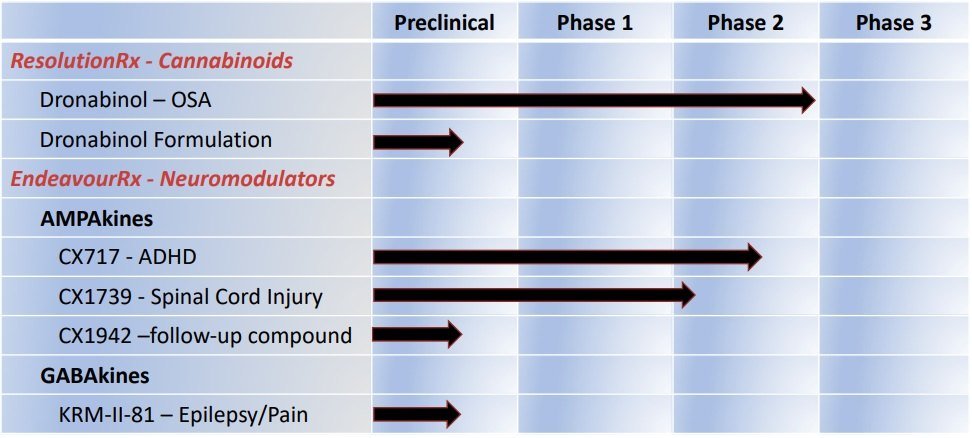
Six programmes across two platforms, with the stage each one has reached.
| Platform | Compound | Indication | Stage |
|---|---|---|---|
| ResolutionRx | dronabinol | Obstructive sleep apnea (OSA) | Phase 2 complete |
| EndeavourRx | CX1739 / CX717 | ADHD | Phase 2 complete |
| EndeavourRx | CX1739 | Spinal cord injury — bladder function | Phase 2 funded |
| EndeavourRx | CX717 / CX1739 | Opioid-induced respiratory depression | Phase 2A complete |
| EndeavourRx | KRM-II-81 | Epilepsy | Translational |
| EndeavourRx | KRM-II-81 | Chronic pain | Preclinical |
ResolutionRx · dronabinol
Obstructive sleep apnea
OSA involves a decrease or complete halt in airflow despite an ongoing effort to breathe during sleep, when soft tissue at the back of the throat collapses and obstructs the airway.
It affects an estimated 29 million people in the United States, a further 26 million in Germany and 8 million in the United Kingdom. Only about 20% of cases in the US — and 20% globally — have been properly diagnosed.
In two Phase 2 clinical trials, dronabinol produced statistically significant improvements in OSA. There are no approved drug treatments for the condition.
Regulatory route
Because dronabinol is an approved molecule, the company believes a 505(b)(2) NDA is available for a new label — relying on data not developed by the applicant, and avoiding duplication of studies already performed.
The programme, in short
- CompoundDronabinol (Δ-9-THC)
- Prior approvalMarinol, 1985 — AIDS anorexia; later chemotherapy nausea
- EvidenceTwo Phase 2 trials, statistically significant
- CompetitionNo approved drug treatment for OSA
EndeavourRx
Four neuromodulator programmes
ADHD
In a Phase 2 clinical trial, one of the lead AMPAkines produced rapid, statistically significant improvement in adults. ADHD affects an estimated 7.8% of US children aged 4–17 and about 4% of US adults.
Spinal cord injury
A Department of Defense award funds a Phase 2 study of CX1739 to improve bladder function in patients with spinal cord injury; preclinical results were published in March 2024.
Epilepsy
Translational studies in human brain tissue from epilepsy patients validated the anti-epileptic effect of the lead GABAkine, KRM-II-81. A case report published in January 2024 showed it suppressed epileptiform activity in that tissue.
Chronic pain
Preclinical pain relief was reported in February 2024 for the non-opioid lead GABAkine.